

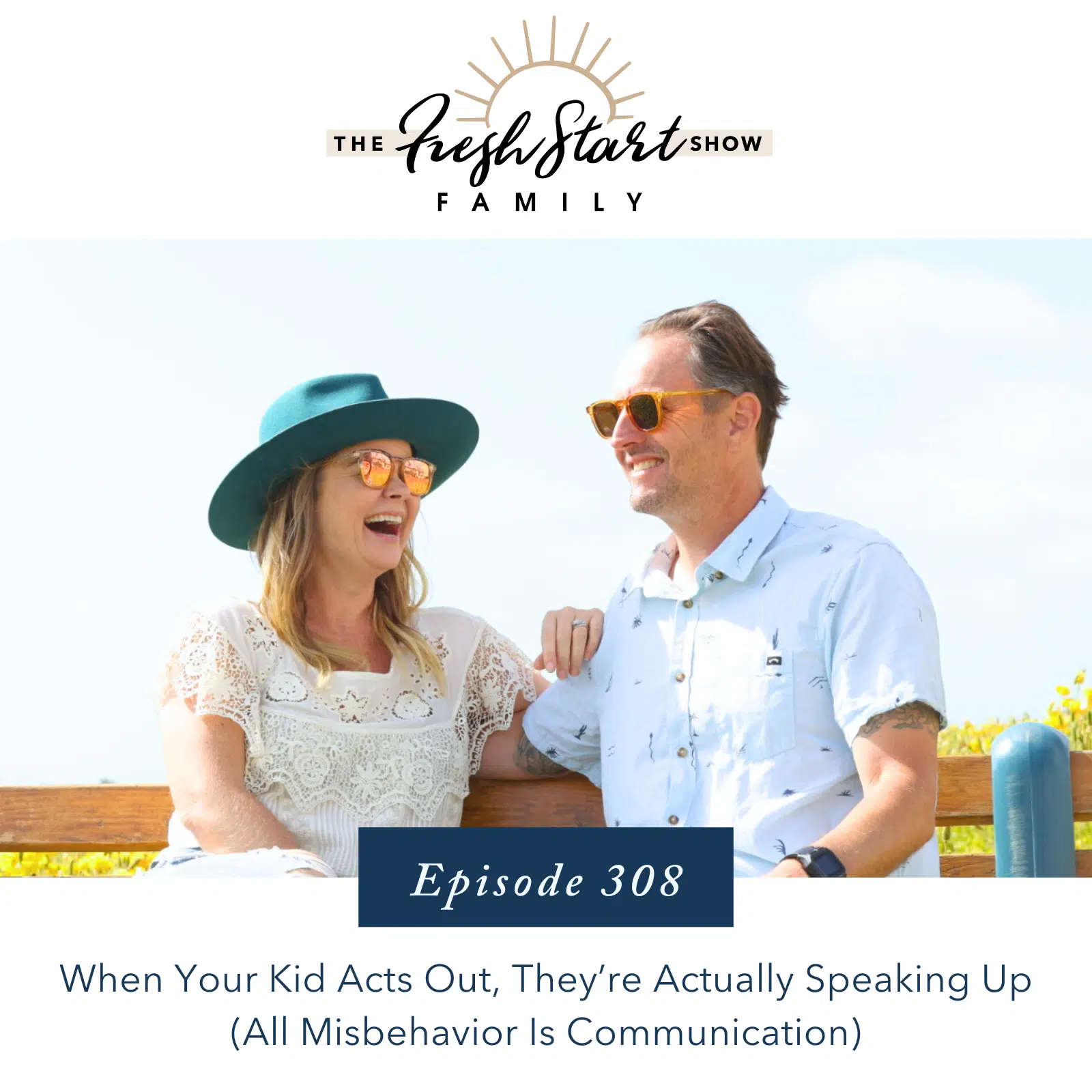
What if misbehavior isn’t defiance, manipulation, or disrespect, but communication?
In this honest, reflective conversation, Wendy and Terry invite us to upgrade our parenting lenses and see our kids, and ourselves, more clearly. Using a powerful “lens” metaphor, they unpack how much of our reactivity is shaped by old conditioning, inherited beliefs, and unconscious power struggles, and how different everything feels when we remove the glare.
Together, they explore why kids act out when needs go unmet, how power struggles form, and what happens when we stop trying to control behavior and start responding with curiosity, leadership, and connection. With real stories from their own family and 15+ years of lived experience, Wendy and Terry show how shifting our paradigm doesn’t just change our parenting, it changes our relationships, our nervous systems, and the legacy we’re building.
If you’ve ever felt triggered, stuck, or unsure how to respond when emotions run high, this episode will help you slow down, see differently, and lead with confidence and compassion.
You don’t have to parent alone.

Enrollment now open for a very limited time! Click here to learn more!
Episode Highlights:
- Misbehavior is communication. When kids act out, they’re signaling unmet needs, not trying to “get away with something.”
- Our reactions are shaped by old lenses. Much of what feels automatic in parenting comes from conditioning we never chose.
- Power struggles dissolve when power is shared. Giving kids healthy ways to lead reduces pushback and rebellion.
- Control isn’t connection. Letting go of micromanaging creates more cooperation, not less.
- Every child has different core needs. Understanding whether your child seeks power, belonging, attention, or reassurance changes how you respond.
- Curiosity is more effective than correction. When we slow down and get curious, influence replaces force.
- Leadership starts with regulation. Calm, embodied parents create safer, more cooperative homes.
- Small paradigm shifts create long-term change. What feels uncomfortable now often builds the leaders we hope to raise later.
Resources Mentioned:
- Preorder your copy of Fresh Start Your Family: Powerful Tools to Bring Peace to Your Home
Unable to listen, or prefer to read along? Here’s the transcript!
Wendy Snyder (00:00)
Hello, families, and welcome back to a new episode of The Fresh Start Family Show. We’re so happy you’re here.
I’ve got Terry with me today, and we’re going to talk about paradigm shifting, how upgrading the lenses we parent through can completely change the way we raise little human souls who grow into big human souls, and how doing this work upgrades our family legacy in the most beautiful way.
Welcome to the show, Terry.
Terry
Thanks. I like the idea of upgrading lenses.
⸻
Wendy (01:00)
I love this analogy because Terry’s been working in the sunglasses world for years, and there really is a difference between wearing regular sunglasses and polarized sunglasses, especially near the ocean.
It’s the same ocean, but with polarized lenses, you can suddenly see deeper. You can see through the glare. You can see the reef. Everything looks different.
Terry
That’s because polarization reduces glare and reflection. Water is a huge reflector, so when you filter that out, the scene flattens and you can see what’s really there. It’s the same thing photographers do with a polarizing lens. You can literally turn it on and off and watch the scene change.
⸻
Wendy (02:30)
That’s such a perfect metaphor for parenting.
Every parent enters parenthood with good intentions. No one signs up wanting to mess their kids up. But so many of us are parenting through lenses shaped by reflection and glare, our upbringing, our family lineage, how discipline was handled, how mistakes were treated.
Stephen Covey said it best: we don’t see the world as it is, we see it as we were conditioned to see it.
And when parents aren’t aware of that conditioning, especially around punishment, shame, guilt, and reactive parenting, those lenses quietly drive their behavior.
Upgrading our lenses means choosing, intentionally, what we believe about kids, misbehavior, and ourselves as parents.
⸻
Wendy (04:15)
Quick note, friends, we’re recording this on a Sunday before church. If you hear a little worship music in the background, enjoy it. We’re multitasking today.
Okay, so as we kicked off the year inside our Fresh Start community, Terry and I reflected on what we learned in 2025 and what we’re taking into 2026. We chose our words of the year, Terry chose trust, I chose simple.
We also hosted the Empowered Parenting Reset, where families set intentions to parent with more connection and less yelling, punishment, and shame.
And now, with the Fresh Start Your Family book officially on pre-order, we thought it would be meaningful to walk through the book together over the next year, touching on different sections and chapters.
This work isn’t theoretical for us. We’ve lived it for 15 years. We’ve raised a child into adulthood using these tools. And that perspective, honestly, is one of the gifts of aging.
⸻
Wendy (06:30)
In Section One of the book, I talk about a foundational belief shift: misbehavior is communication.
So many of us grew up believing that kids misbehave because they’re bad, disobedient, selfish, or trying to push buttons. And that belief quietly turns into: misbehaving child equals bad child equals bad parent.
That last part, bad parent, is the biggest trigger for most parents.
But when you study trusted psychology, specifically Adlerian psychology, you learn that all humans have core needs: to belong, to feel powerful, to feel valuable, to be loved, and I always add, to feel safe.
When those needs aren’t met, kids do what adults do too, they act out in unhealthy ways to try to meet them.
That’s true for kids and grown-ups alike.
So the new lens we teach is this:
A misbehaving child is a communicating child, and that creates an empowered parent who can redirect and teach life skills with dignity, connection, and grace.
⸻
Wendy (08:45)
When you truly trust this lens, it’s freeing. You stop taking things personally. You stop seeing your child as the enemy.
And you start noticing how uniquely designed each child is.
Stella, for example, has always had a strong power need. Belonging and value matter too, but power is her primary driver.
Taryn, on the other hand, leans more toward belonging and attention. He’ll still joke at the dinner table or ask outright, “Can you ask me questions? I want attention.”
And what’s beautiful is that once kids understand their own needs, they stop fighting them and start communicating them.
⸻
Wendy (10:30)
I’ve also noticed this work has helped me recognize my own wiring.
I love feeling powerful. I have to practice stepping back, letting others lead, especially when it doesn’t actually matter.
Whether it’s customer service, driving directions, or letting someone else handle a situation, awareness has been huge for me.
And that’s part of the paradigm shift too, realizing that parenting isn’t about controlling everything. Releasing control can feel terrifying, but it’s actually incredibly safe and effective.
⸻
Wendy (11:45)
So Terry, when you look back over the last 15 years, how has this paradigm shift impacted our family and our relationship with the kids?
Terry
I think the first shift is recognizing what paradigm you’re even in. That takes humility.
You almost have to step outside yourself for a moment and observe the dynamic, what your child is doing, what you’re doing, how you were raised, and where you want to go.
I recently talked with a coworker who has a three- or four-year-old and said, “I feel like he’s manipulating me.”
That word, manipulating, gets thrown around a lot. And I gently reminded him, this little guy can barely wipe his own butt. He hasn’t masterminded psychological warfare. He’s just learned that certain behaviors get a reaction.
Kids repeat what works.
That doesn’t make them bad. It means they’re human.
⸻
Terry (14:00)
When parents believe their kids are out to get them, they tend to escalate. The dance becomes: you push, I push harder.
But when you recognize that kids are communicating unmet needs, everything changes.
Then you can ask, what am I bringing to the table? My temperament, my need for control, my upbringing?
There’s nothing wrong with wanting control or leadership. But awareness lets you soften where needed.
And for power-driven kids, one of the most effective things you can do is give them power proactively, not reactively.
Let them lead something. Give them responsibility. Put them in charge of a task, a project, a role.
When their power bucket is full, they stop demanding it through conflict.
⸻
Wendy (16:30)
Yes. This shows up in the smallest moments, like letting a child handle a customer service situation, sell rocks on the sidewalk, choose their outfit, or take the lead on something low-stakes.
I remember Stella wanting to sell rocks on a Monday morning. My instinct was, “No, that’s ridiculous.”
But once I let go, she made money, felt capable, and walked away empowered.
Those moments matter.
When kids feel trusted and capable at home, they don’t need to grab power out in the world through rebellion later.
⸻
Wendy (18:30)
So here’s a reflective question for you as you listen:
When you feel the urge to control, ask yourself, Why is it important that I control this?
And then ask, Is this an opportunity to let my child lead?
If it’s not, that’s okay. Find another moment that is.
This work takes time. It takes years. Be patient with yourself.
But we consistently see that when parents give kids appropriate power at home, kids demand less power outside the home.
⸻
Terry (20:00)
I always think about the long road. Are you raising a future leader, or a compliant follower?
The world needs leaders.
That means practicing leadership with your kids, not forcing obedience for convenience.
⸻
Wendy (21:15)
And this applies to all kids, not just strong-willed ones. Kids who struggle with belonging, anxiety, or inadequacy benefit just as much.
Once you upgrade your lens, you become more effective everywhere, not just at home.
I’ve even noticed how this work changed the way I talk to people on the phone, customer service, support teams, anyone. Compassion and connection work better than intimidation every time.
That’s true with kids too.
⸻
Wendy (22:45)
This old paradigm we were handed isn’t fact. It’s just one way of seeing the world, and in my experience, it’s incredibly ineffective long-term.
A new lens gives you influence, confidence, and peace.
If you want to go deeper into this work, Section One of Fresh Start Your Family walks you through these belief shifts step by step.
You can pre-order now at freshstartfamilyonline.com/preorder, and thank you, truly, for supporting this book. Pre-orders matter more than most people realize.
⸻
Wendy (24:15)
Alright, families, that’s it for today. We’re heading into church early for once, which feels powerful in itself.
Thank you for listening. If these episodes are helpful, please follow, subscribe, and leave a review. And don’t forget to pre-order Fresh Start Your Family.
We’ll see you next time.